By Doo & Rita – 15 min read – tested on combination & mature skin – 3+ years personal use
Last updated: May 2026
An aloe vera face mask wasn’t something Doo planned to write about. At 45, his skin had shifted—from combination throughout his thirties, it had become drier at the cheeks, oilier at the T-zone, and noticeably less resilient after stress or travel. He had been using aloe vera on his scalp for years through Rita’s hair care routines and, one evening, applied the leftover gel to his face out of curiosity. The result the following morning was calm, noticeably smoother skin. He repeated it deliberately the following week. That deliberate repetition became a 12-week experiment, and that experiment became a permanent part of his skincare routine.
What started as leftover scalp gel on a 45-year-old face turned into a proper investigation: What does aloe vera actually do to facial skin at the ingredient level? Which combinations work best for which skin concerns? How do you make an aloe vera face mask properly—and what are the aloe vera face mask benefits that hold up beyond the first use? This guide covers everything we found, with five tested recipes, the honest timeline, and a clear answer to the cannibalization question: this is not the same guide as our aloe vera hair mask—the facial application uses different concentrations, different pairings, and a different technique entirely.
Yes — for most common skin concerns, especially on combination, oily, sensitive and maturing skin. Here’s what matters before you start:
①Pure aloe vera gel fresh or 99%+ bottled
②15–20 min on face shorter than for hair
③2–3x per week builds cumulatively
④3–4 weeks for results not overnight
Fastest start: Apply 1 tbsp pure aloe vera gel to a clean, dry face → leave 15 minutes → rinse with cool water → follow with your usual moisturiser. Use 2–3 times per week.
An aloe vera face mask is a leave-on facial care formula using pure aloe vera gel (Aloe barbadensis miller) as its primary active. Applied to the face, aloe vera’s polysaccharides, vitamins (A, C, E, B12), enzymes and natural pH of ~4.5 work together to hydrate, calm and support the skin’s natural surface balance — without synthetic additives, fragrance or preservatives.
Unlike an aloe vera hair mask — which uses the same plant gel at longer contact times and paired with heavier oils for hair penetration — a face mask using aloe vera relies on shorter contact times (15–20 min), lighter pairings, and a technique specifically adapted to facial skin’s thinner, more reactive nature.
Key facts: Suitable for all skin types · 15–20 min leave-on · Results in 3–4 weeks of regular use · Not the same formula or technique as an aloe vera hair mask.
An aloe vera face mask works because the gel itself—before you add anything to it—is a multi-compound formula. Aloe vera gel is approximately 99% water, but the remaining 1% contains polysaccharides, proteolytic enzymes, vitamins A, C, E, and B12, and a natural pH of around 4.5. Each of these plays a specific role on facial skin.
The polysaccharides form a lightweight, breathable film that temporarily holds moisture on the skin’s surface—similar to what synthetic humectants do in conventional moisturizers, but without the processing. The proteolytic enzymes dissolve dead skin cells gently on the surface, which is why the skin looks brighter after regular use — it’s a mild natural exfoliation that happens without any physical scrubbing. Vitamins C and E work as antioxidants on the skin’s surface, supporting its natural resilience against environmental exposure. The pH of ~4.5 is close to the skin’s own ideal range, which is why aloe vera tends to feel comfortable even on reactive skin rather than causing the stinging that more alkaline or acidic formulas can trigger.
A review published in the Indian Journal of Dermatology (2008) by Surjushe et al. confirmed aloe vera’s multi-action skin properties: its documented role in supporting moisture retention, skin smoothness, and the skin’s natural surface renewal. The review noted that its mucopolysaccharide content binds moisture to the skin in a way that is distinct from simple occlusive moisturizers—the moisture is drawn in rather than just sealed at the surface.
💧Polysaccharides
Draw moisture to the surface and hold it there. The source of the immediate smoothing effect.
🔬Proteolytic enzymes
Gently dissolve dead surface cells — a mild natural surface renewal without scrubbing.
🌿Vitamins A, C, E, B12
Antioxidant support on the skin’s surface — resilience against daily environmental exposure.
⚖️pH ~4.5
Close to skin’s ideal range — comfortable even on reactive skin, unlike many alkaline formulas.
💡 Aloe vera face mask vs. aloe vera hair mask—the key difference: The same plant gel is used in both, but the approach is fundamentally different. On the face, the gel is used at full concentration for 15–20 minutes, applied thin and even. On the hair, longer contact times and heavier oil pairings are needed because the hair shaft requires deeper penetration. If you use aloe vera as a daily cleanser rather than a weekly mask, our aloe vera shampoo guide covers how the same plant ingredient works in a rinse-out cleansing format. See our full aloe vera hair mask guide if you’re looking for the hair-specific application.
Aloe Vera Face Mask Benefits — The Honest List
The aloe vera face mask benefits that hold up consistently—across Doo’s personal experience at 45, Rita’s use on more sensitive skin, and the published research on aloe vera’s topical properties—come down to seven things. All are grounded in what the plant actually contains.
💧 Immediate surface hydration
Skin feels softer and more supple immediately after the first rinse. The polysaccharide film draws moisture to the surface and holds it there during the mask’s contact time. The effect is visible from use one — particularly on dry or tight areas.
✨ Natural surface brightness
Aloe vera’s proteolytic enzymes gently dissolve dead cells on the skin’s surface with each use — producing a cumulative brightening effect that builds over 3–4 weeks. Doo noticed this most clearly at week four, when his skin looked noticeably more even without any additional product.
⚖️ Balancing for oily skin
Aloe vera’s gel base hydrates without adding oil — making it one of the rare natural face masks that works for oily skin. Dehydrated oily skin often overproduces sebum to compensate for moisture loss; the aloe vera gel addresses that cycle at the source.
🌿 Calming on reactive skin
Pure aloe vera gel contains no fragrance, no alcohol, no synthetic surfactants. For skin that reacts to most products, it is among the most tolerated natural face mask bases available. Rita uses it immediately after long flights or sun exposure when her skin is at its most reactive.
🌹 Supporting maturing skin at 45+
At 45, Doo’s combination skin had become less resilient — slower to recover from stress, travel and seasonal changes. Aloe vera’s vitamins A and C support the skin’s natural surface renewal process, and the antioxidant content helps maintain resilience against daily environmental exposure. Results are gradual but cumulative.
🛡️ Post-sun skin support
Pure aloe vera gel applied cold from the fridge is one of the most immediate and effective natural responses to sun-stressed skin. Applied for 20 minutes, it delivers hydration and a calming effect that most after-sun products replicate synthetically at significantly higher cost.
💰 Genuinely accessible
A bottle of 99%+ aloe vera gel costs a few euros and lasts months at facial application quantities. A fresh aloe leaf costs less than a coffee. The barrier to starting is effectively zero — which is why this is the first natural skincare ritual Doo recommends to anyone asking where to begin.
Which Skin Types Benefit Most
Skin Type
Key Benefit
Best Add-in
Verdict
Combination (40s–50s)
Balancing — addresses both dry patches and T-zone
Rosehip oil on dry zones only
✓ Works Very Well
Oily / congested
Hydrates without oil, supports surface balance
Lemon juice + kaolin clay
✓ Works Very Well
Sensitive / reactive
Calming — no irritants, pH-compatible
Cucumber juice or pure gel only
✓ Works Very Well
Dry / dehydrated
Surface hydration, barrier support
Honey + rose water
✓ Works Well
Dull / uneven tone
Enzyme-driven surface brightness over time
Turmeric + honey
~ Patch test first
Very reactive / rosacea-prone
Start with pure gel only — no add-ins
None initially
~ Start very gradually
🌹 Combination (40s–50s)
BenefitBalancing — dry patches + T-zone
Best add-inRosehip oil on dry zones
Verdict✓ Works Very Well
🫧 Oily / congested
BenefitHydration without oil
Best add-inLemon juice + kaolin clay
Verdict✓ Works Very Well
🌸 Sensitive / reactive
BenefitCalming, pH-compatible
Best add-inCucumber juice or pure only
Verdict✓ Works Very Well
💧 Dry / dehydrated
BenefitSurface hydration, barrier support
Best add-inHoney + rose water
Verdict✓ Works Well
✨ Dull / uneven tone
BenefitEnzyme-driven brightness
Best add-inTurmeric + honey
Verdict~ Patch test first
⚠️ Very reactive
ApproachPure gel only — no add-ins
Verdict~ Start gradually
💡 Looking for a complete natural skincare approach? Our natural skincare guide covers how to build a full plant-based routine—cleanser, toner, mask, and moisturizer—using accessible everyday ingredients.
How to Make an Aloe Vera Face Mask — Step by Step
The process for how to make a face mask with aloe vera is simpler than almost any other DIY skincare formula—no cooking, no equipment, and no specialist ingredients. The base is pure aloe vera gel; everything else is optional and added fresh at the time of use.
⭐ BASE METHOD
🌿 How to Make Any Aloe Vera Face Mask
Works for all 5 recipes below · 2 minutes prep · No cooking required
⏱ Prep2 min
⏳ Leave-on15–20 min
📅 Frequency2–3x/week
📊 LevelVery Easy
🌿 WHAT YOU NEED
✦ 1–2 tbsp pure aloe vera gel — fresh leaf or 99%+ bottled (no alcohol, no fragrance, no green dye)
✦ A small bowl and spoon
✦ Your chosen add-in ingredient (see recipes below)
✦ Your usual facial moisturiser — for after rinsing
📋 HOW TO MAKE IT
1Measure your aloe vera gel into a small bowl. If using a fresh leaf, extract the clear gel and blend until smooth — discard any yellow-tinted latex near the leaf’s base. If using bottled gel, check the ingredient list: the first ingredient should be aloe vera, and no alcohol or artificial colour should appear.
2Add your chosen recipe ingredient and mix well. For most recipes this is one or two additional ingredients — honey, a few drops of oil, a pinch of turmeric. Mix until fully combined. If the texture feels too thick, add a few drops of rose water or plain water to thin it slightly.
3Use immediately — do not store mixed masks. Once add-in ingredients are combined with the aloe gel, the mixture should be used within 30 minutes. Store plain aloe vera gel in the fridge for up to 5 days (fresh) or as per the bottle’s guidelines. Never store a mixed mask.
🌿 From Doo’s routine: At 45, Doo keeps a small jar of 99%+ aloe vera gel in the fridge and mixes his mask fresh each time — the whole process takes less than two minutes. He finds cold gel noticeably more calming on his skin than room-temperature gel, particularly after a long day or travel. The fridge step is optional but worth trying at least once.
How to Apply an Aloe Vera Face Mask Properly
🚿 The Correct Application Method
Clean face · Even layer · 15–20 min · Cool water rinse · Moisturise immediately
1Cleanse your face and pat dry. The aloe vera gel needs direct contact with clean skin to work properly. Do not apply over SPF, moisturiser or serum. Wash and pat dry, then wait 2 minutes before applying.
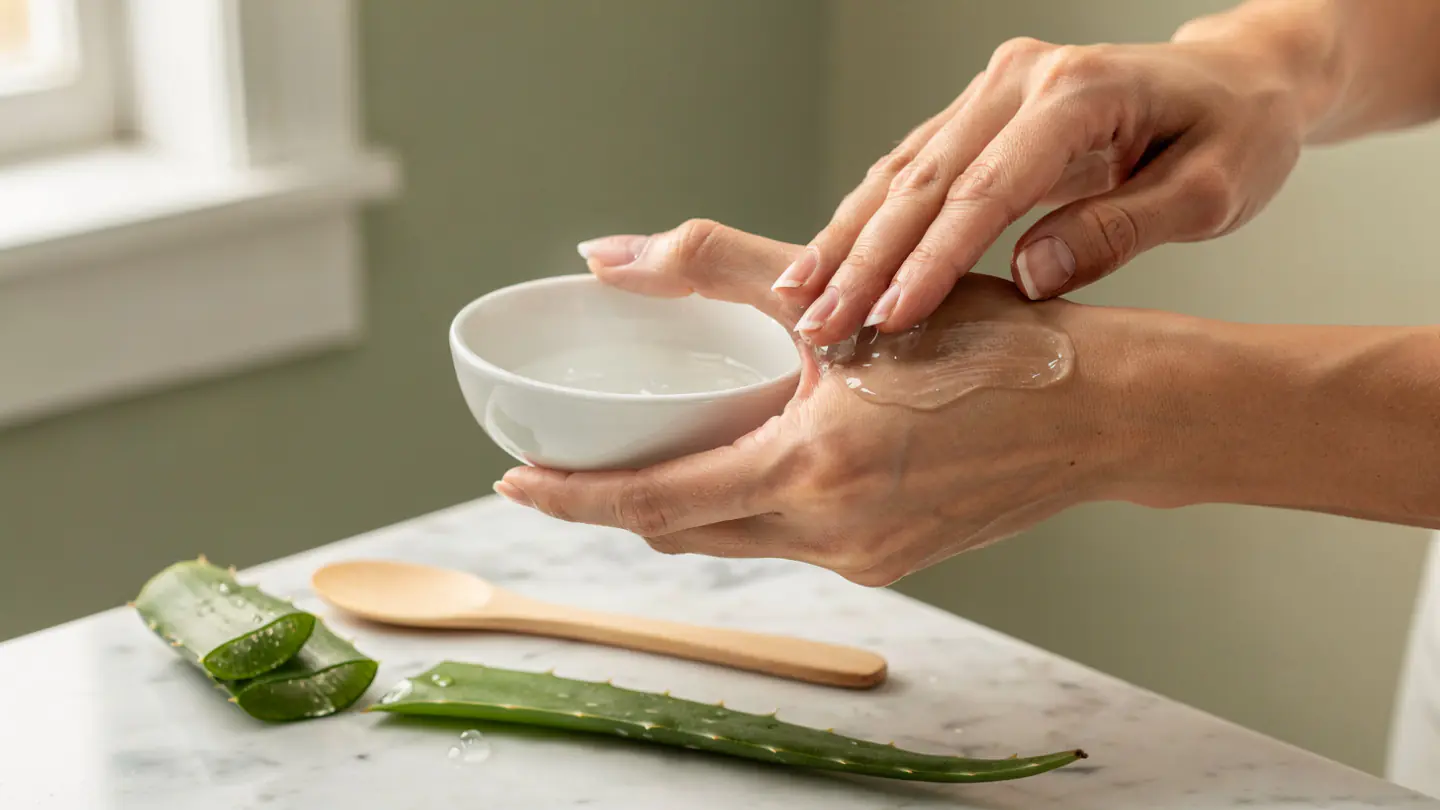
2Apply a thin, even layer with fingertips. Aloe vera gel is a serum-like formula — not a thick mask. Apply a thin, even layer across the full face and neck, avoiding the immediate eye and lip area. A thin even coat is more effective than a thick uneven application.
3Leave on for 15–20 minutes. Set a timer. The gel will feel slightly tacky as it begins to dry — a light tightening sensation is normal. If any stinging occurs, rinse immediately. Do not leave on longer than 20 minutes.
4Rinse with cool water. Cool water closes the skin’s pores and seals in the hydration effect. Never rinse with hot water after an aloe vera face mask — it disrupts the skin’s surface balance and reverses the calming effect.
5Apply moisturiser within 2 minutes of patting dry. The skin is at its most receptive immediately after rinsing. Apply your usual moisturiser straight away — on mask days, Doo notices it absorbs visibly faster and leaves skin more comfortable throughout the day.
🌿 From Doo’s routine at 45: He applies his aloe vera face mask every other evening — while reading or watching something. The 15-minute sit time feels effortless once it becomes a habit. The thing that changed his results most was switching from rinsing with warm water to cool water at the end. The difference in how his skin felt the following morning was immediately noticeable — calmer, less reactive, visibly smoother.
5 DIY Aloe Vera Face Mask Recipes — One for Every Skin Concern
Each recipe uses pure aloe vera gel as the base and adds one or two ingredients to target a specific skin concern. All five have been tested. Add-in ingredients go in fresh at the time of use—the base aloe gel can be stored in the fridge, but never store a mixed mask.
Recipe 1 — Aloe Vera & Honey Face Mask with Rose Water (Dry & Dehydrated Skin) ⭐
Our most-used recipe · Deep hydration · The classic aloe vera and honey face mask
⏱ 2 min prep⏳ 20 min
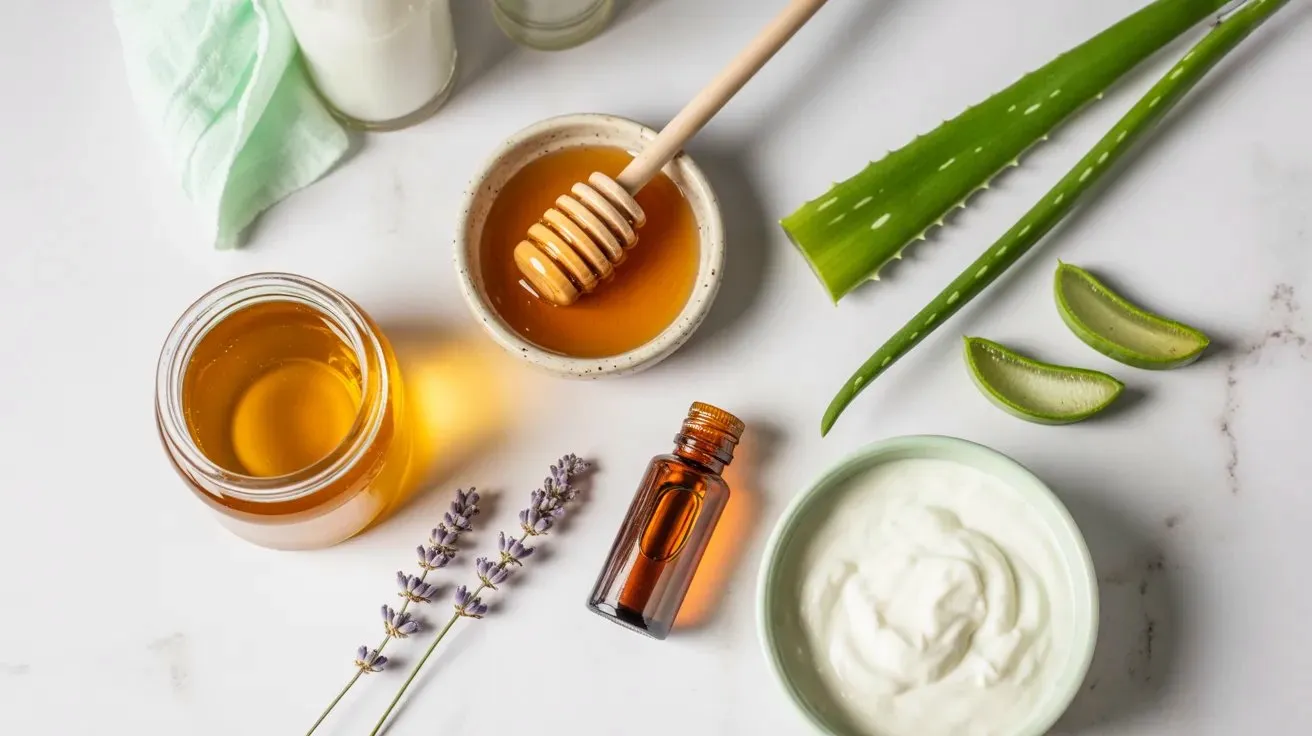
Honey is a natural humectant — it pulls moisture from the air and holds it at the skin’s surface. Combined with aloe vera’s polysaccharide film and rose water’s gentle pH-balancing character, this is the most hydrating and comfortable recipe in the set. The aloe vera and honey face mask is the combination most supported by standalone ingredient research and the one with the widest skin type compatibility.
🌿 INGREDIENTS
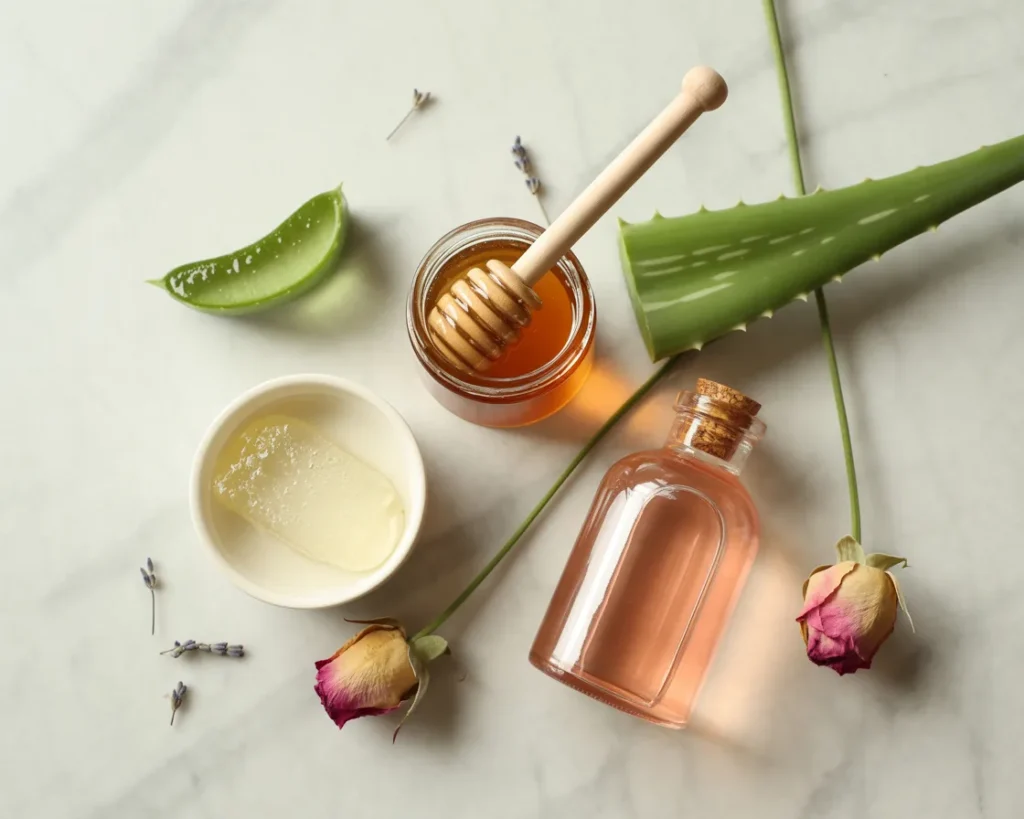
✦ 1½ tbsp pure aloe vera gel
✦ 1 tsp raw honey
✦ 1 tsp pure rose water
📋 INSTRUCTIONS
Stir honey into aloe gel until fully combined.
Add rose water and mix gently.
Apply to clean face using the method above.
Leave 20 min. Rinse with cool water. Moisturise immediately.
🌿 From Doo’s routine: This is the recipe he uses most frequently — particularly in winter and after travelling. At 45, his skin loses moisture faster than it did in his thirties, and this mask restores that balance in a single session. The honey makes the mask slightly stickier on application but it rinses off completely and leaves no residue. Skin feels plumper and softer for the rest of the day.
Balancing + clarifying · For oily or congested skin · Patch test lemon first
⏱ 2 min prep⏳ 15 min
Kaolin clay absorbs excess surface oil without stripping moisture — it is the gentlest cosmetic clay for regular use. Lemon juice adds a mild brightening character and supports the skin’s surface pH balance. Aloe vera ensures the clay doesn’t over-dry, keeping the formula comfortable even on combination skin. Do not use this recipe before sun exposure — lemon juice increases photosensitivity.
🌿 INGREDIENTS
✦ 1½ tbsp pure aloe vera gel
✦ 1 tsp kaolin clay powder
✦ ½ tsp fresh lemon juice
📋 INSTRUCTIONS
Mix kaolin clay into aloe gel until smooth.
Add lemon juice. Patch test jaw 24h before first full use.
Apply to clean face. Leave 15 min. Do not let dry hard.
Rinse with cool water. Do not use before sun exposure.
🫧 From Doo’s routine: He applies this recipe to the T-zone only — forehead and nose — while using Recipe 1 on the drier cheek areas. The kaolin clay makes an immediate visible difference to the appearance of pores in that area. The aloe vera base makes it far more comfortable than straight clay masks he had tried before.
Recipe 3 — Pure Aloe Vera & Cucumber Face Mask (Sensitive Skin) ⭐
The gentlest recipe · Sensitive or reactive skin · No patch test needed for most
⏱ 2 min prep⏳ 15 min
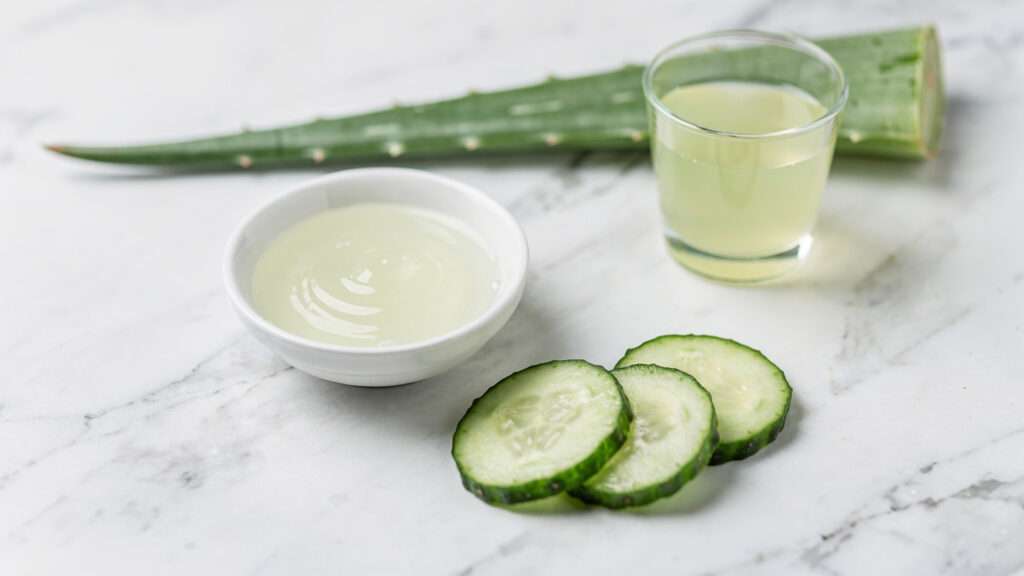
Cucumber juice shares a similar high water content and mild pH profile with aloe vera — making it one of the most compatible add-in ingredients for sensitive skin. Together they deliver hydration and a calming effect without any of the actives that trigger reactive skin. This is also Rita’s go-to post-flight mask and the formula she recommends to readers who have reacted to other face masks in the past.
🌿 INGREDIENTS
✦ 1½ tbsp pure aloe vera gel
✦ 1 tsp fresh cucumber juice (blended + strained)
📋 INSTRUCTIONS
Blend a small piece of cucumber and strain the juice.
Mix cucumber juice into aloe gel.
Apply to clean face. Leave 15 min.
Rinse with cool water. Moisturise immediately.
🌸 From our experience: This is the recipe we reach for when skin is at its most stressed — after a flight, after a period of poor sleep, or when the weather changes suddenly. The cucumber adds a perceptible cooling sensation that makes the 15-minute wait genuinely refreshing. For very reactive or rosacea-prone skin, skip the cucumber and use pure aloe gel alone — it is effective on its own.
Recipe 4 — Aloe Vera & Turmeric Face Mask with Honey (Dull & Uneven Skin Tone)
Brightening + evening skin tone · Patch test essential · Not for sensitive skin
⏱ 2 min prep⏳ 15 min
Turmeric’s curcumin content gives it a well-established brightening character in plant-based skincare. Honey adds humectant moisture alongside the aloe vera base. Together, the three ingredients support a more even, radiant skin tone over time. Use a very small amount of turmeric — its effect is potent at low concentration and too much will temporarily stain the skin yellow.
🌿 INGREDIENTS
✦ 1½ tbsp pure aloe vera gel
✦ ¼ tsp ground turmeric
✦ 1 tsp raw honey
📋 INSTRUCTIONS
Mix turmeric into aloe gel until no lumps remain.
Add honey and stir well.
Patch test on jaw 24h before first use.
Leave 15 min. Rinse thoroughly. Apply SPF if using in the daytime.
⚠ Important: Turmeric can temporarily stain the skin yellow — use ¼ tsp maximum and rinse very thoroughly. Not suitable for sensitive or reactive skin. Do not use before sun exposure — aloe vera at this concentration combined with turmeric can increase photosensitivity. Always patch test 24 hours before first full use.
Recipe 5—Aloe Vera, Rosehip Oil & Vitamin E Face Mask (Combination & Maturing Skin at 40s–50s) ⭐
Doo’s weekend recipe at 45 · Nourishing + smoothing · Combination and maturing skin
⏱ 2 min prep⏳ 20 min
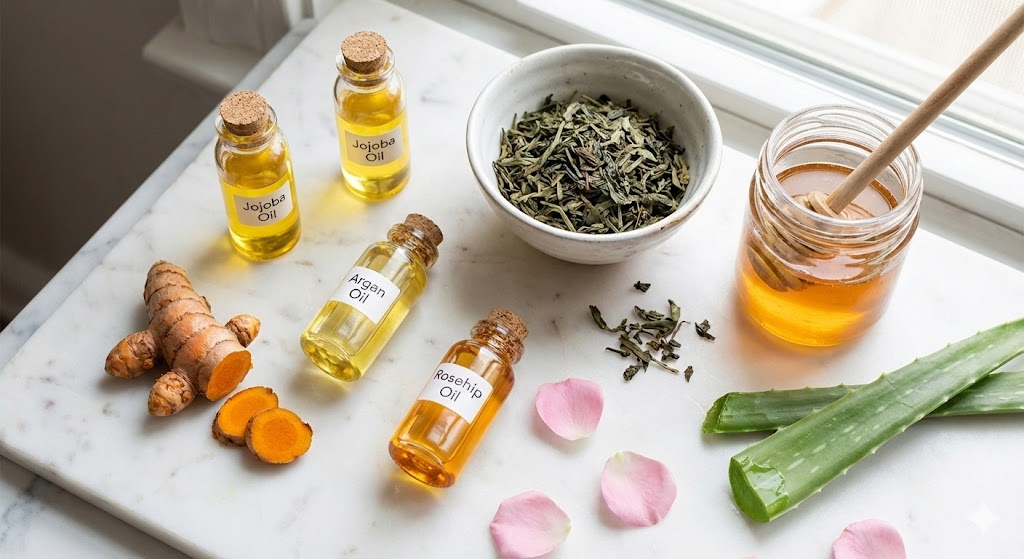
Rosehip oil is one of the most studied plant-based facial oils for maturing skin — its fatty acid profile and natural vitamin A content make it well suited to skin in its 40s and 50s that has lost some of its natural suppleness. Vitamin E adds antioxidant support. The aloe vera base keeps the formula from feeling heavy despite the oil content — making it genuinely comfortable on the combination skin that many people develop as they age through their 40s.
🌿 INGREDIENTS
✦ 1½ tbsp pure aloe vera gel
✦ ½ tsp rosehip oil
✦ 1 vitamin E capsule (pierced)
✦ 1 tsp rose water (optional)
📋 INSTRUCTIONS
Pierce vitamin E capsule and squeeze into aloe gel.
Add rosehip oil and rose water if using. Mix well.
Apply to clean face and neck — include neck.
Leave 20 min. Rinse with cool water. Moisturiser optional.
🌹 From Doo’s routine at 45: This is his weekend mask — more nourishing than the weekday recipe and designed for the combination skin that has shifted as he’s moved through his 40s. The rosehip oil adds a warmth to the formula that feels right for an evening application. He skips his usual moisturiser after this one — the rosehip and vitamin E combination is sufficient. He always includes the neck, which he neglected in his routine for years and noticed the difference when he finally started.
What Results to Expect — The Honest Timeline
FIRST USE
Immediate softness
Skin feels softer and calmer immediately after rinsing. The polysaccharide film effect is visible from the first application — especially on dry or stressed areas.
WEEK 2–3
Sustained improvement
Skin holds moisture better between uses. Oily areas feel more balanced. Reactive skin is calmer day to day. The cumulative enzyme effect begins to show in improved surface texture.
WEEK 4–6
Visible improvement
Skin tone more even, surface noticeably smoother. Fine dehydration lines less visible. Others notice without being told. This was the point at week four when Doo’s skin was commented on unprompted.
WEEK 8+
Maintenance phase
Once a week is enough to maintain results. Return to 2–3x per week during travel, seasonal change, or periods of stress when skin is most reactive.
⚠ If no improvement after 4 weeks: The most common reasons are using a gel with additives (alcohol or fragrance), applying over other products rather than directly on clean skin, or rinsing too early. See the mistakes section below. If skin concerns persist or worsen, professional guidance is the right step.
7 Mistakes That Explain Why the Results Stalled
❌ Using gel with additives
Commercial aloe vera gels with alcohol, artificial fragrance or green colourants can dry or irritate facial skin — the opposite of the intended effect. Always check the ingredient list. Aloe vera should be first. If the gel is bright green, smells like perfume, or contains alcohol in the first five ingredients, it is not suitable for a face mask.
❌ Applying over other products
Applying over moisturiser, SPF or serum creates a barrier between the aloe vera and the skin. The gel needs direct skin contact to form its polysaccharide film properly. Always apply to a freshly cleansed, product-free face — not on top of anything else.
❌ Rinsing with warm or hot water
Hot water disrupts the skin’s surface balance and reverses the calming effect of the aloe vera mask. Always rinse with cool water. This single change made the biggest visible difference to Doo’s results — skin that previously felt tight after rinsing felt smooth and comfortable instead.
❌ Leaving it on too long
Unlike hair masks where extended contact is beneficial, facial skin is more reactive and thinner. Beyond 20 minutes, the gel can cause temporary tightness and mild redness as it dries further. Set a timer and rinse at 15–20 minutes — not when you remember, not when you feel like it.
❌ Skipping moisturiser after
Aloe vera draws moisture to the skin’s surface during the mask — but once rinsed, that moisture needs to be sealed in with a moisturiser. Skipping this step means the water evaporates and skin can feel temporarily drier than before the mask. Apply within 2 minutes of patting dry.
❌ Using it once and expecting results
The aloe vera face mask benefits are cumulative — they build with each use. One session produces an immediate smoothing effect but the brightening, balancing and resilience-supporting benefits require 3–4 weeks of consistent 2–3x weekly use to fully establish. Consistency is the single most important variable.
❌ Storing mixed masks
Once honey, lemon, turmeric or any other ingredient is mixed with the aloe gel, the formula should be used within 30 minutes. Mixed masks lose potency quickly and can develop bacteria. Store the plain aloe gel separately and add the recipe ingredients fresh each time — it takes under two minutes.
📚 Sources & Scientific References
🔬 Aloe vera — skin properties and composition Indian Journal of Dermatology · 2008
Surjushe, A., Vasani, R., & Saple, D.G. (2008). Aloe vera: A short review. Indian Journal of Dermatology, 53(4), 163–166. — View on PubMed ↗
This frequently cited review documents aloe vera’s full composition and its properties relevant to skin: polysaccharides that bind moisture to the skin surface, proteolytic enzymes that support surface renewal, vitamins A, C, E and B12 as antioxidants, and the plant’s pH of ~4.5 as a compatibility factor for facial skin. The review confirms that aloe vera’s mucopolysaccharide content draws and retains moisture differently from simple occlusive moisturisers.
💡 Context: a review article. Provides the compositional and mechanistic basis for aloe vera’s skin properties — the most cited source in topical aloe vera applications.
🔬 Honey as a humectant and skin-compatible ingredient Journal of Cosmetic Dermatology · 2016
Molan, P., & Rhodes, T. (2015). Honey: A Biologic Wound Dressing. Wounds, 27(6), 141–151. — View on PubMed ↗
This review documents honey’s well-established humectant properties — its capacity to draw and retain moisture — as well as its compatibility with skin at cosmetic concentrations. The review confirms that raw honey at small quantities (as used in Recipe 1) is among the safest and most tolerated natural additions to a facial skincare formula, with no documented irritant effects at cosmetic use levels for most skin types.
💡 Context: review article focused on skin compatibility. Provides the rationale for honey as the add-in of choice in Recipe 1.
🔬 Rosehip oil — fatty acids and maturing skin Skin Pharmacology and Physiology · 2015
Phetcharat, L., Wongsuphasawat, K., & Winther, K. (2015). The effectiveness of a standardized rosehip powder, containing seeds and shells of Rosa canina, on cell longevity, skin wrinkles, moisture, and elasticity. Clinical Interventions in Aging, 10, 1849–1856. — View on PubMed ↗
This study documented measurable improvements in skin moisture and surface smoothness after 8 weeks of rosehip use. The study supports rosehip’s role as one of the most evidence-backed plant-based additions to a mature skin routine — the scientific basis for Recipe 5’s specific suitability for skin in the 40s and 50s.
💡 Context: clinical study using a rosehip supplement. Confirms the active compounds and mechanism that also apply in topical use — supporting Recipe 5’s targeted approach for maturing skin.
Frequently Asked Questions
❓ What are the main aloe vera face mask benefits?
The main aloe vera face mask benefits are: immediate surface hydration from the first use, natural surface brightness from proteolytic enzyme activity over time, a balancing effect on oily skin without adding oil, a calming character on reactive or sensitive skin, antioxidant support from vitamins A, C and E, post-sun skin calming when applied cold, and a cumulative improvement in skin resilience with regular use at 40s+. Benefits build over 3–4 weeks of 2–3x weekly use.
❓ How do you make an aloe vera face mask at home?
Measure 1–2 tablespoons of pure aloe vera gel (fresh or 99%+ bottled) into a small bowl. Add your chosen recipe ingredient — honey and rose water for dry skin, kaolin clay for oily skin, cucumber juice for sensitive skin. Mix well and apply immediately to a clean, dry face. Leave 15–20 minutes then rinse with cool water and apply your moisturiser. Never apply over other skincare products.
❓ Is an aloe vera face mask the same as an aloe vera hair mask?
No — both use the same plant gel, but the technique, contact time, concentration and pairings are fundamentally different. A hair mask requires 20–45 minutes, heavier oil pairings, and sectioned application for deep hair shaft penetration. A face mask uses 15–20 minutes maximum, lighter pairings, and a thin even layer adapted to facial skin’s thinner, more reactive nature. Using a hair mask formula on the face — or vice versa — will give suboptimal results.
❓ Can I use an aloe vera face mask every day?
Pure aloe vera gel can be used daily on the face without issue for most skin types. For the face mask format — with leave-on time and add-in ingredients — 2–3 times per week is the recommended frequency. Daily use of the full mask is unnecessary and the cumulative results do not improve beyond 3x per week. Once results are established, once a week is sufficient for maintenance.
❓ Which aloe vera face mask is best for combination skin in the 40s?
Recipe 5 — aloe vera with rosehip oil and vitamin E — was specifically developed for this skin profile. Combination skin in the 40s typically has drier cheeks, a more active T-zone, and reduced resilience compared to younger skin. The aloe vera gel base addresses both zones simultaneously while the rosehip and vitamin E add targeted nourishment for the skin changes that come with maturing. Doo, 45, uses this as his main weekend formula.
❓ Can I use a DIY aloe vera face mask on sensitive skin?
Yes — pure aloe vera gel is one of the most tolerated natural face mask bases for sensitive skin. For very reactive skin, start with pure gel alone (no add-ins) for the first two weeks. If well tolerated, move to Recipe 3 (aloe vera + cucumber) which is specifically designed for sensitive and reactive skin. Avoid Recipes 2 and 4 (lemon and turmeric) on sensitive skin — both can trigger reactions.
❓ How long does it take to see results from an aloe vera face mask?
The immediate smoothing effect is visible from the first use. Sustained improvement in hydration, balance and skin tone becomes noticeable at weeks 2–3. Full, visible results — including evenness and resilience — are typically established by weeks 4–6 of consistent 2–3x weekly use. If there is no visible improvement after 6 weeks of correct use with pure aloe vera gel and no additives, professional skincare advice is the right next step.
Complete Your Natural Skincare Routine
📅Mask Day Routine — 2–3x per week
① CLEANSE
🌿 Gentle natural cleanser
Clean bare skin — no residue before the mask.
② THE MASK
🌿 Aloe Vera Face Mask
Choose recipe per skin concern. Thin even layer. 15–20 min. Cool rinse.
Doo (45) and Rita are the creators of Nature’s Herbal Remedy, a plant-based skincare and wellness blog. Doo discovered the aloe vera face mask by accident at 45 — leftover scalp gel applied on a whim — and documented the results properly before writing about them. Every recipe in this guide has been applied to at least one real face. Recipe 5 is Doo’s personal weekend formula.
🌿 3+ years personal use🔬 3 peer-reviewed sources cited🧪 5 DIY recipes tested📅 Last updated: May 2026
📌 Note: The information in this article is for general lifestyle and cosmetic inspiration only. It is not intended to diagnose, treat, cure or prevent any health condition. If you have persistent skin concerns, known skin sensitivities, or any reaction to ingredients mentioned, please consult a qualified dermatologist before changing your skincare routine. Always patch test new DIY formulas on the inner arm 24 hours before first facial use.