By Doo & Rita – 13 min read – tested on flaky & unbalanced scalps – 4+ years personal use
Last updated: May 2026
Tea tree shampoo for dandruff was not something Doo went looking for intentionally. He started using tea tree shampoo because of an oily scalp and noticed almost as a side effect that the flaky patches he’d had on and off for years quietly disappeared around week four. We didn’t connect the two things immediately. It took a deliberate two-week pause from the shampoo—and the return of the flakes—to understand what had actually been happening.
That observation turned into a proper investigation: What does tea tree oil actually do for a flaky scalp? What does the research say? Does it work for all types of dandruff? And how do you use it correctly to get consistent results rather than occasional ones? This guide is everything we found — plus three DIY recipes we’ve tested ourselves, the mistakes that explain why it stops working, and the honest answer to whether it can replace a medicated shampoo.
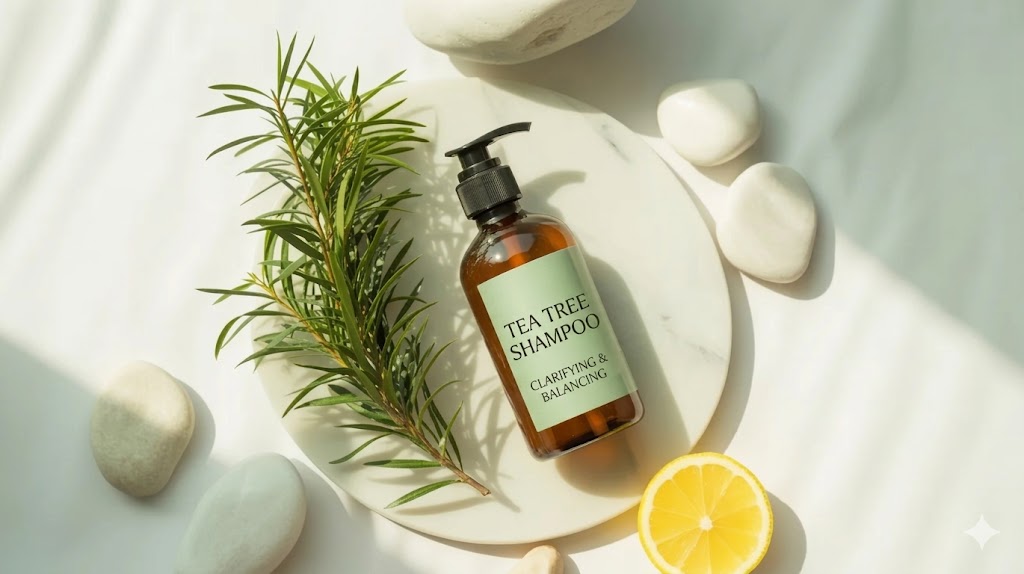
Tea tree shampoo for dandruff uses the naturally purifying properties of tea tree oil (Melaleuca alternifolia) — specifically its active compound terpinen-4-ol — to support a more balanced scalp environment and reduce the flaking associated with an unbalanced scalp.
A randomised study by Satchell et al. (2002) published in the Journal of the American Academy of Dermatology found that a 5% tea tree oil shampoo reduced dandruff by 41% over four weeks compared to a placebo shampoo.
Key facts: Works on most common dandruff types · Requires 3–5 minute leave-on · Results in 4–6 weeks · Does not replace professional guidance for severe or persistent cases.
What Does Tea Tree Shampoo Actually Do for Dandruff?
Tea tree shampoo for dandruff works differently from most anti-dandruff shampoos because it addresses the scalp environment rather than just the visible symptom. Most dandruff—particularly the kind that comes and goes, worsens in winter, or responds to stress—is connected to an imbalanced scalp rather than a structural hair problem. Tea tree oil’s active compound, terpinen-4-ol, supports a more balanced scalp environment at the source.
The most commonly cited research—a 2002 randomized study by Satchell et al.—compared a 5% tea tree oil shampoo against a placebo over four weeks and found a 41% reduction in dandruff in the tea tree group versus 11% in the placebo group. That gap is significant, and it points to a genuine mechanism rather than a placebo effect. The key variable, as with all tea tree applications, is concentration: the 5% threshold matters, and most commercial shampoos fall below it.
What tea tree shampoo does not do is bleach, strip, or dry out the scalp the way some conventional anti-dandruff formulas can. Used correctly, it supports the scalp’s natural balance rather than overriding it—which is why the results tend to be more sustainable over time rather than requiring indefinite use at maximum frequency.
🌿41% reduction
In dandruff severity over 4 weeks at 5% concentration. Source: Satchell et al., 2002.
⚖️Scalp Balance
Addresses the environment — not just the visible flaking on the surface.
🔬Terpinen-4-ol
The active compound responsible for the purifying effect. 30–48% of tea tree oil composition.
📅4–6 weeks
Consistent timeline for visible, lasting improvement with correct use.
The 3 Types of Dandruff — and Which Ones Tea Tree Actually Helps
Not all flaking has the same cause—and tea tree shampoo is more effective for some types than others. Understanding which type you’re dealing with is the most important step before starting any routine.
Type
What It Looks Like
Tea Tree Verdict
Our Tip
Scalp imbalance flaking
Fine white flakes, oily scalp, comes and goes seasonally
✓ Works Very Well
3–5 min leave-on, 3x/week
Dry scalp flaking
Small dry flakes, tight scalp, worsens in winter or with hard water
✓ Works Well
2 min, diluted, always condition
Stress or diet-related
Flaring during stressful periods, inconsistent pattern
~ Partial help
Helps scalp balance — not the underlying cause
Product buildup flaking
Waxy or thick flakes, concentrated near the hairline
~ Use clarifying first
Clarifying shampoo to clear buildup, then tea tree
Persistent or severe
Very thick, yellow or greasy flakes, significant redness
⚠ See a professional
Tea tree alone is not enough — consult a dermatologist
💡 The hard water factor: a significant proportion of what looks like dandruff is actually mineral deposit buildup from hard water sitting on the scalp. Tea tree shampoo addresses scalp imbalance—but it doesn’t remove mineral deposits. If you live in a hard water area and your flaking returns quickly after improvement, a weekly apple cider vinegar rinse or a rice water rinse addresses the mineral component that tea tree oil cannot.
How to Use Tea Tree Shampoo for Dandruff: 4 Methods
The method matters more than the product. Using tea tree shampoo like a regular shampoo—applying, lathering, and rinsing immediately—gives the active compounds almost no time to do their work. The difference between “it didn’t work” and “it cleared up in four weeks” is almost always the leave-on time.
All dandruff types · The 3-minute leave-on that makes the difference · Replace your regular shampoo
⏱ Time5–7 min
📊 LevelVery Easy
📅 Frequency3x/week
✨ Best ForAll Types
🌿 WHAT YOU NEED
✦ Tea tree shampoo at 5%+ concentration — check the ingredient list
✦ Lukewarm water — not hot
✦ A timer — the most important tool in this guide
✦ Conditioner for mid-lengths to ends
📋 HOW TO DO IT
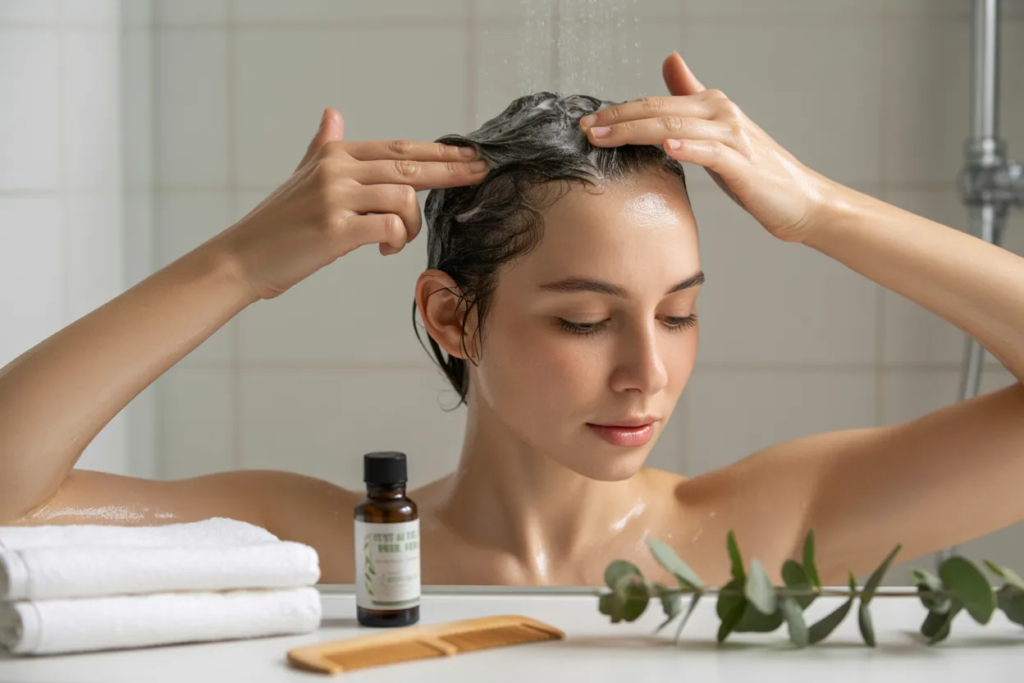
1Wet the scalp thoroughly. Lukewarm water only — hot water disrupts the scalp’s natural balance and can worsen flaking over time. Make sure the entire scalp is saturated before applying.
2Apply directly to the scalp in sections. Don’t squirt onto the lengths. Use your fingertips to distribute across the entire scalp — pay particular attention to the areas where flaking is most visible.
3Massage for 60–90 seconds, then start the timer. Firm circular motions across the entire scalp. Then leave on for 3 minutes without rinsing. This is the step that makes or breaks the results.
4Rinse very thoroughly. Residue left on the scalp irritates — the opposite of what you want when dealing with flaking. Rinse until the water runs completely clear, then rinse a little more.
5Condition mid-lengths to ends only. Never apply conditioner to the scalp after tea tree shampoo — it coats the scalp and reduces the purifying effect. Lengths only, leave 2–3 minutes, rinse with cool water.
🌿 From our routine: Doo used to rinse immediately after lathering, for three weeks, and noticed almost no improvement. Adding the 3-minute leave-on in week four changed everything. Within two weeks of that change, the flaky patches that had been a fixture since winter were gone. The timer is the single most important variable in this entire guide — more important than which brand you use.
Method 2 — Extended Leave-On for Persistent Flaking
⏱ Method 2 — Extended Leave-On
For persistent flaking that hasn’t responded to the standard method · 5–10 minutes · 3x per week
⏱ 5–10 min🌿 3x/week
If the standard 3-minute method hasn’t produced visible improvement after two weeks, extending the leave-on time gives the active compounds more contact time with the scalp. Use this as a correction phase — not a permanent routine.
🌿 WHAT’S DIFFERENT
✦ Leave on 5–10 minutes instead of 3
✦ Use a shower cap to maintain warmth
✦ Section the scalp — work in 4 parts
✦ Reduce to standard method once flakes clear
📋 WHEN TO USE THIS
✦ After 2 weeks standard method with no change
✦ Seasonal flare-up — winter or dry climate
✦ Stop if any irritation develops
⏱ From our routine: Rita used this method during a particularly dry winter when her usual frequency wasn’t keeping up with seasonal flaking. Three weeks at 5–10 minutes three times a week brought things back under control. She then dropped back to the standard method for maintenance. The extended leave-on is a correction tool, not a daily approach.
Method 3 — Oily Scalp + Dandruff Combined Method
🫧 Method 3 — Oily Scalp + Dandruff
When flaking and excess oil appear together · Extended massage · The most common combination
⏱ 7–10 min🌿 3x/week
Oily scalp and dandruff often appear together — excess sebum creates the environment that allows scalp imbalance to thrive. This method addresses both at once through an extended massage that physically loosens buildup alongside the tea tree’s purifying action.
🌿 WHAT YOU NEED
✦ Tea tree shampoo — generous amount
✦ Optional: 2 drops peppermint oil added to the shampoo
✦ Cool water for final rinse
📋 HOW TO DO IT
Apply to wet scalp. Massage 2–3 minutes in firm circular motions.
Leave on 5 minutes. Use the time to condition your lengths.
Rinse scalp thoroughly with cool water.
Repeat 3x per week. Reduce frequency as scalp balances.
🫧 From our routine: This was Doo’s starting point — his oily scalp and the occasional flaking were connected. Addressing the oil overproduction through the extended massage method resolved both simultaneously. The peppermint addition is optional but noticeably amplifies the cooling sensation and the scalp clarity — see our full tea tree shampoo guide for the complete peppermint method.
Method 4 — Gentle Approach for Sensitive Scalp with Flaking
Reactive or sensitive scalp · Diluted introduction · Patch test first
⏱ 2 min max🌸 2x/week
A sensitive scalp that is also flaking needs a gentler introduction. Starting diluted and building up gradually avoids the irritation that can make flaking worse rather than better. The tea tree lavender blend in the DIY recipes below is specifically designed for this scenario.
🌿 FIRST TWO WEEKS
✦ Mix 1 part tea tree shampoo + 2 parts gentle shampoo
✦ Leave on 90 seconds maximum
✦ Patch test on wrist before first scalp use
📋 WEEKS 3+ IF NO REACTION
✦ Move to undiluted — 2 minutes
✦ Increase to 3 minutes if well tolerated
✦ Stop immediately if burning develops
🌸 From our experience: A reader with a reactive scalp had tried tea tree twice before — both times at full concentration from day one, both times with irritation that worsened the flaking. The diluted introduction over two weeks allowed her to build up to the standard method without any reaction. She reported noticeable improvement by week five.
3 DIY Tea Tree Shampoo Recipes for Dandruff
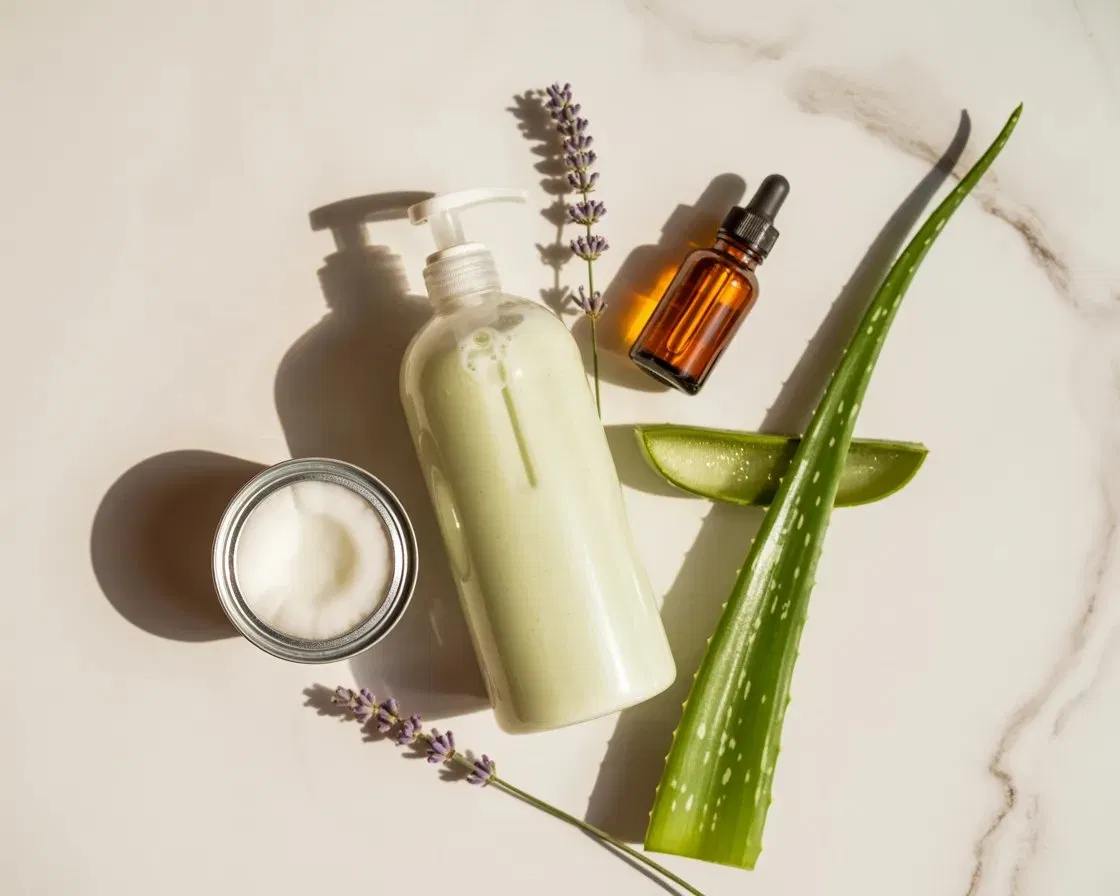
These three recipes are specifically formulated for flaky scalps—each with a different supporting ingredient that complements tea tree oil’s purifying properties. All three use a castile soap base, hit the 5% tea tree concentration that research points to as effective, and have been tested in our own bathroom. Store in the fridge and follow the use-by guidance for each.
Recipe 1 — Tea Tree & Apple Cider Vinegar Dandruff Shampoo ⭐
Our most-used recipe · Balances scalp pH · Works on oily + flaky scalp
⏱ 5 min prep🌿 Use within 1 week
Apple cider vinegar balances the scalp’s natural pH — an imbalanced pH is one of the environmental factors that allows scalp imbalance to persist. Combined with tea tree’s purifying action, this is the most comprehensive natural approach to dandruff in a single formula. Read more about ACV’s scalp benefits in our apple cider vinegar for hair guide.
🌿 INGREDIENTS
✦ 100ml unscented liquid castile soap
✦ 20 drops pure tea tree essential oil
✦ 2 tbsp raw apple cider vinegar
✦ 2 tbsp pure aloe vera gel
✦ 1 tsp jojoba oil (for dry ends)
📋 INSTRUCTIONS
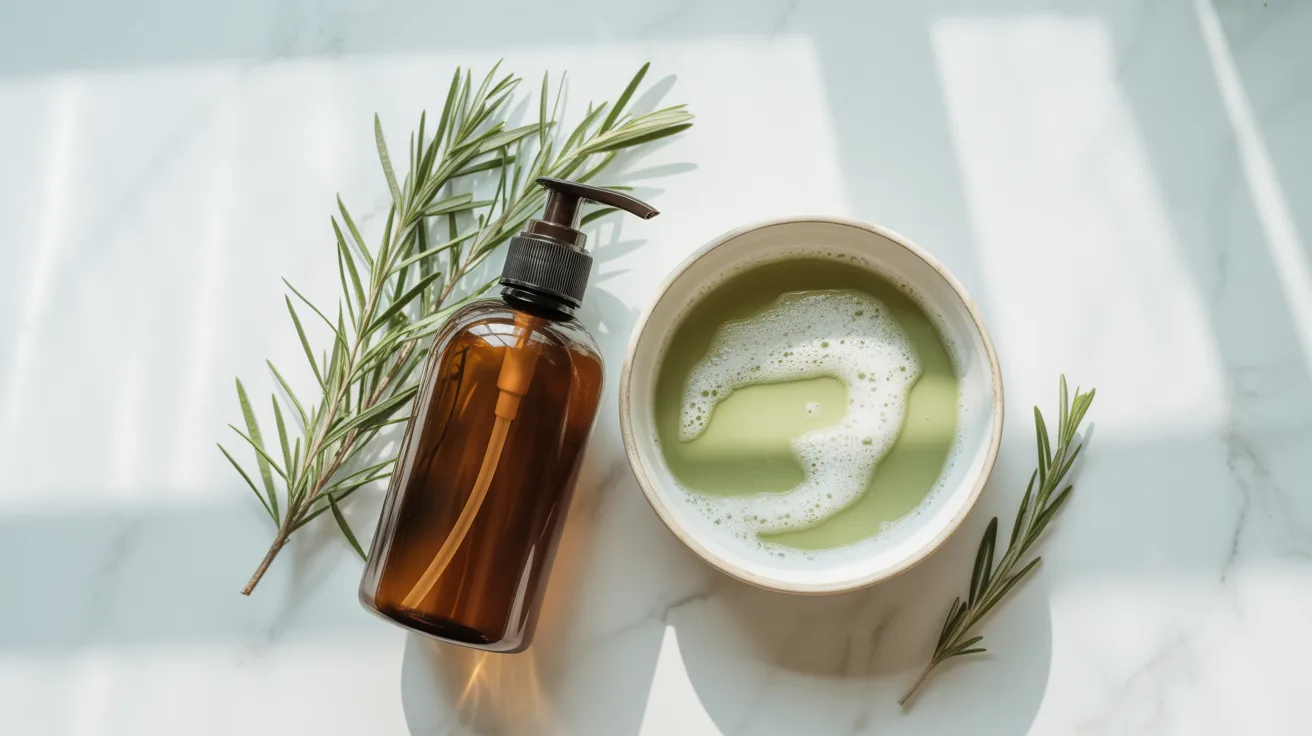
Combine castile soap and aloe vera in a clean pump bottle.
Add apple cider vinegar, tea tree oil and jojoba oil.
Invert gently 3–4 times — do not shake vigorously.
Store in fridge. Use within 1 week. Shake gently before each use.
🌿 From our routine: This is the recipe Doo keeps in the fridge during winter when his scalp is most prone to flaking. The apple cider vinegar gives the formula a slight tang in the shower — not unpleasant, and completely gone once rinsed. The jojoba oil is optional but makes the formula noticeably gentler on the lengths. Apply using the standard 3-minute method above.
Recipe 2 — Tea Tree & Rosemary Scalp-Balancing Shampoo
Scalp balance + circulation · Normal to oily scalp · Every 2–3 days
⏱ 5 min prep🌱 Use within 2 weeks
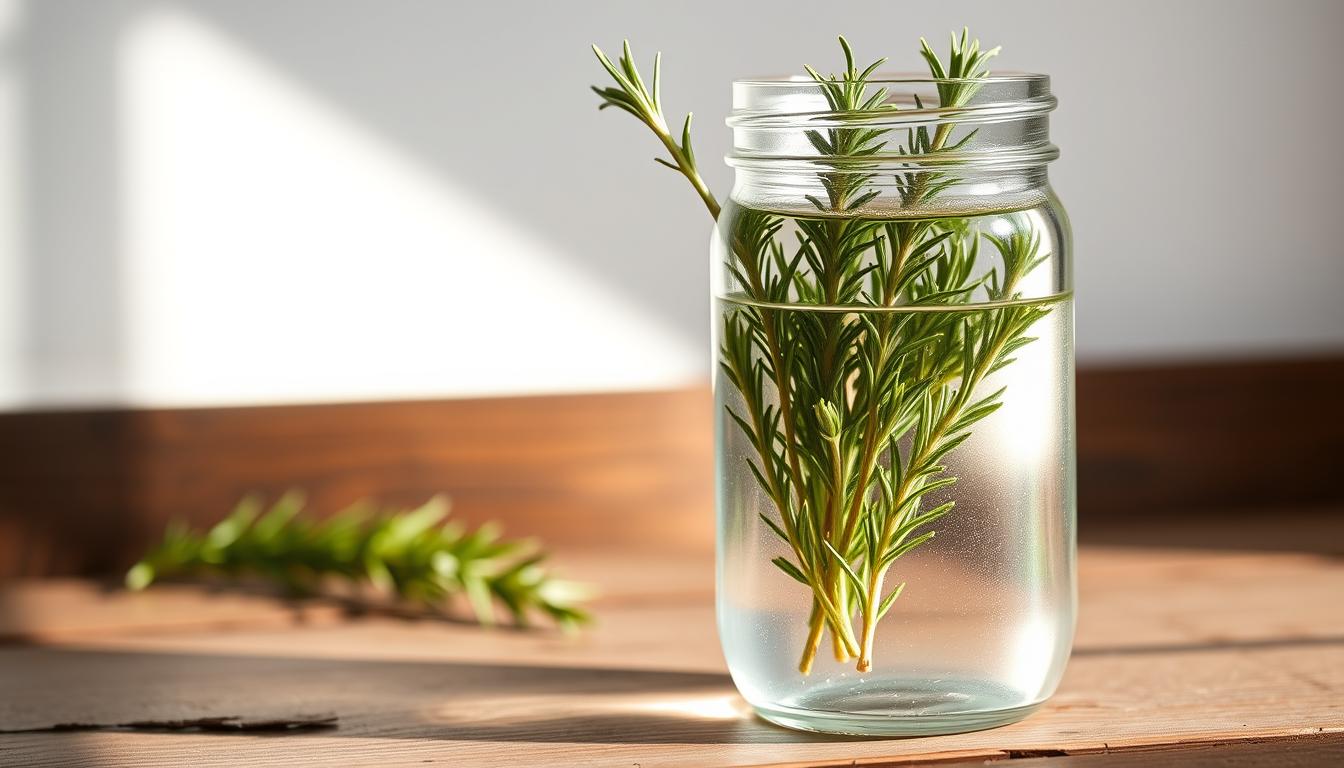
Rosemary is one of the most studied plant ingredients for scalp circulation. Combined with tea tree’s purifying properties, this formula supports both scalp balance and the overall health of the scalp environment. We use brewed rosemary water as the liquid base rather than plain water — it adds the active compounds directly into the formula.
Combine castile soap, aloe vera and cooled rosemary water.
Add both essential oils.
Invert gently 3–4 times to combine.
Store in fridge. Use within 2 weeks.
🌱 From our routine: Rita alternates between this formula and the ACV recipe week by week. The rosemary version has a more herbal, forest-like scent that she prefers in cooler months. The combination of tea tree and rosemary in the same formula means one step rather than two — shampoo and scalp support in a single application.
Sensitive or dry scalp + flaking · Calming formula · Patch test first
⏱ 5 min prep💜 Use within 10 days
Neem oil has been used in traditional Ayurvedic scalp care for centuries and is among the most studied plant-based ingredients for scalp wellness. Its strong, distinctive smell is completely masked by the lavender in this formula — but patch test first as neem is potent.
🌿 INGREDIENTS
✦ 100ml unscented liquid castile soap
✦ 15 drops pure tea tree essential oil
✦ 10 drops lavender essential oil
✦ 1 tsp neem oil
✦ 2 tbsp aloe vera gel
📋 INSTRUCTIONS
Warm the neem oil slightly if solid — it needs to be liquid to mix.
Combine all ingredients in a pump bottle. Invert gently.
Patch test on wrist 24 hours before first scalp use.
Store in fridge. Use within 10 days.
💜 From our routine: This is the formula we reach for when a scalp is both flaking and feeling reactive or tight at the same time. The lavender genuinely moderates the intensity of the tea tree — making it the right formula for anyone who found the pure tea tree approach too strong. The neem smell is noticeable in the bottle but disappears almost entirely after rinsing.
Tea Tree Shampoo vs Medicated Anti-Dandruff Shampoo — When to Use Which
This is the question we get most from readers who are considering switching from a conventional anti-dandruff shampoo to a natural approach. Here is an honest framework for deciding which one your scalp actually needs.
⚖️ Tea Tree vs Medicated Shampoo — The Decision Framework
An honest comparison — not a sales pitch for either option
🌿 Use Tea Tree Shampoo When:
Flaking is mild to moderate and comes and goes
Scalp is oily or imbalanced alongside the flaking
You prefer a plant-based, natural approach
Conventional shampoos have worked but you want to reduce product load
Flaking is seasonal or stress-related
You want a long-term maintenance approach
⚕️ Consider Professional Guidance When:
Flaking is severe, persistent and doesn’t respond to natural approaches
Flakes are thick, yellow or accompanied by significant redness
The scalp is visibly inflamed or uncomfortable
You’ve used tea tree consistently for 8+ weeks with no improvement
Flaking is spreading beyond the scalp
You have a known scalp concern requiring professional care
⚖️ Our honest take: Tea tree shampoo is genuinely effective for the most common types of dandruff. But it is a natural wellness product, not a clinical intervention. If your scalp concern is significant, persistent, or accompanied by discomfort that doesn’t improve after consistent use, a dermatologist or trichologist is the right next step — not more tea tree shampoo.
What Results to Expect — The Honest Timeline
WEEK 1–2
Scalp feels cleaner
The immediate post-wash sensation improves. Hair stays fresher between washes. Flaking may not have visibly reduced yet — this is normal.
WEEK 3–4
Flaking reduces
Most people notice a meaningful reduction in visible flaking at this stage. The scalp feels more comfortable and balanced day-to-day.
WEEK 5–6
Stable improvement
Flaking has reduced significantly or cleared. This is when you transition from correction frequency (3x/week) to maintenance (2x/week).
WEEK 8+
Maintenance phase
Continue at 2x/week to prevent recurrence. If flaking returns fully, return to 3x/week for 2–3 weeks then reduce again.
⚠ If no improvement by week 6: Review the mistakes section below — the most common reasons for lack of results are leaving on too briefly, using a formula with insufficient tea tree concentration, or washing too infrequently. If you’ve ruled all of these out and there’s still no change after 8 weeks of consistent correct use, consider speaking to a professional.
8 Mistakes That Explain Why the Dandruff Came Back
Most people who try tea tree shampoo for dandruff and don’t get lasting results made one of these eight mistakes: Everything is based on real experience—ours or that of readers who reported back.
❌ Not Leaving It On
Applying and rinsing immediately is the single most common reason tea tree shampoo doesn’t work for dandruff. 3 minutes minimum. Set a timer. The active compounds need contact time with the scalp to do anything useful.
❌ Stopping Too Early
Two weeks is not enough time. The research shows meaningful results at four weeks — and most people stop around week two when they don’t see immediate transformation. Six weeks is the minimum fair assessment period.
❌ Using a Formula Below 5%
A shampoo that lists tea tree oil at position 15 of 18 ingredients will not produce the results documented in the Satchell et al. study. Check the ingredient position. If it’s in the bottom third, the concentration is cosmetic rather than functional.
❌ Washing Only Once a Week
For dandruff correction, once a week is not enough. Two to three times per week gives the active compounds consistent contact with the scalp environment. Once a week is a maintenance frequency — not a correction one.
❌ Applying Conditioner to the Scalp
Conditioner applied to the scalp coats the follicle openings and blocks the tea tree compounds from working. Conditioner belongs on mid-lengths and ends only — never the scalp. This is especially important when addressing dandruff.
❌ Using Hot Water
Hot water disrupts the scalp’s natural balance, strips protective oils, and can worsen flaking over time. Lukewarm water for the wash, cool water for the final rinse. This alone can make a visible difference within two weeks.
❌ Not Addressing Hard Water
If you live in a hard water area, mineral deposits on the scalp can mimic or worsen dandruff — and tea tree shampoo alone cannot remove them. Add a weekly apple cider vinegar rinse to address the mineral component alongside the tea tree routine.
❌ Using It on the Wrong Type of Dandruff
Tea tree shampoo works well for scalp imbalance flaking and dry scalp flaking. It works less well for product buildup flaking (use a clarifying shampoo first) and is not appropriate as a standalone approach for severe or persistent cases. Know which type you’re dealing with before starting.
📚 Sources & Scientific References
We’re not dermatologists. We’re two people who noticed a real change in a real scalp and wanted to understand why. Here are the studies we found most credible and most relevant to the specific question of tea tree shampoo for dandruff.
🔬 5% tea tree shampoo — the foundational dandruff study Journal of the American Academy of Dermatology · 2002
Satchell, A.C., et al. (2002). Treatment of dandruff with 5% tea tree oil shampoo. Journal of the American Academy of Dermatology, 47(6), 852–855. — View on PubMed ↗
A randomised, single-blind, parallel-group study of 126 participants comparing a 5% tea tree oil shampoo against a placebo over four weeks. The tea tree group showed a 41% improvement in dandruff severity compared to 11% in the placebo group. Scalp oiliness and itchiness also improved more significantly in the tea tree group. The researchers attributed the effect to terpinen-4-ol, tea tree oil’s primary active compound.
💡 Context: single-blind design — participants knew which product they were using. Results are meaningful but should be interpreted with this limitation in mind. The 5% concentration is the specific threshold tested — not a general claim for all tea tree products.
Carson, C.F., Hammer, K.A., & Riley, T.V. (2006). Melaleuca alternifolia (Tea Tree) Oil: a Review of Antimicrobial and Other Medicinal Properties. Clinical Microbiology Reviews, 19(1), 50–62. — View on PubMed ↗
A comprehensive review confirming that terpinen-4-ol — representing 30–48% of tea tree oil’s composition — is the primary active compound responsible for its purifying properties. The review also notes that concentration and formulation significantly affect outcomes, supporting the importance of checking where tea tree oil appears in a shampoo’s ingredient list before purchasing.
💡 Context: a review article — not an original trial. Provides the scientific mechanism behind why tea tree oil works for scalp imbalance.
🔬 Apple cider vinegar and scalp pH International Journal of Trichology · 2014
Gavazzoni Dias, M.F. (2015). Hair cosmetics: an overview. International Journal of Trichology, 7(1), 2–15. — View on PubMed ↗
This review covers scalp pH as a factor in scalp health, noting that an imbalanced scalp pH can support the conditions that lead to flaking and scalp imbalance. Mildly acidic rinses — such as diluted apple cider vinegar — help restore pH balance. This is the scientific basis for combining a tea tree shampoo routine with a periodic ACV rinse, particularly for persistent dandruff.
💡 Context: a review article. Provides the rationale for the ACV rinse combination — not a direct study on ACV for dandruff specifically.
🧪 How We Tested — & What Actually Changed
Using tea tree shampoo for dandruff was not a deliberate experiment for Doo — it was an accidental discovery that became a deliberate investigation. Here is what “tested by us” means in this guide.
🌿 The dandruff discovery was accidental
Doo started using tea tree shampoo for an oily scalp. Around week four, he noticed the flaky patches he’d had since the previous winter had disappeared. He didn’t connect it to the shampoo until he stopped for two weeks to test — and the flakes returned by day ten.
⚠️ The leave-on finding came from failure first
For the first three weeks, he rinsed immediately after lathering. Almost no improvement. Adding the 3-minute leave-on in week four produced a visible change within two more weeks. The leave-on time is not a detail — it is the mechanism.
🍎 The ACV recipe came from a hard water problem
After moving to a hard water area, Doo noticed his flaking returned faster than before despite using the same routine. Adding the apple cider vinegar to the DIY recipe formula made the difference. This observation is what led us to understand that hard water mineral buildup is a separate factor from scalp imbalance.
🌱 The rosemary recipe came from wanting a scent alternative
Rita found the pure ACV formula too sharp-smelling in winter months. The rosemary version was tested over six weeks as an alternative — producing comparable results with a more pleasant experience. She alternates between the two seasonally.
💜 The neem recipe came from a reader request
Several readers with sensitive, reactive scalps wrote in after finding pure tea tree too intense. We developed the lavender-neem formula specifically for this scenario and tested it over four weeks before including it in this guide.
📚 The research confirms what we observed
The 41% dandruff reduction in the Satchell et al. study at 5% concentration is consistent with what Doo experienced at a comparable concentration. We cite it because it explains the mechanism — not because it guarantees identical results for everyone.
🌿 Tea tree shampoo for dandruff is one of the most evidence-backed natural scalp approaches available. The research is solid, the mechanism is well understood, and the DIY option is genuinely simple. What it requires is patience, the right method, and a willingness to give it six weeks before judging. If it doesn’t produce results after that — with the correct concentration and leave-on time — a professional conversation is the right next step.
Frequently Asked Questions
❓ Does tea tree shampoo actually work for dandruff?
Yes — for most common dandruff types. A randomised study by Satchell et al. (2002) found that a 5% tea tree oil shampoo reduced dandruff severity by 41% over four weeks compared to 11% in the placebo group. The key variables are concentration (5% minimum), leave-on time (3 minutes minimum), and frequency (2–3 times per week). Doo’s dandruff cleared at week four after adding the leave-on step — having seen almost no change in the three weeks before that when he rinsed immediately.
❓ How long does tea tree shampoo take to clear dandruff?
The scalp feels cleaner from the first correct use. Visible reduction in flaking typically appears at weeks 3–4 of consistent use 2–3 times per week. Stable, lasting improvement is usually established by weeks 5–6. If there is no meaningful improvement after 8 weeks of correct use at 5% concentration with a 3-minute leave-on, consider speaking to a professional.
❓ How do you use tea tree shampoo for dandruff properly?
Apply to wet scalp, massage 60–90 seconds in circular motions, leave on for 3 minutes minimum, rinse very thoroughly, then condition mid-lengths to ends only — never the scalp. Use 2–3 times per week. The 3-minute leave-on is the step most people skip and the most important variable in the entire routine.
❓ Can I make a DIY tea tree shampoo for dandruff at home?
Yes — and the DIY option has one significant advantage: you control the tea tree concentration precisely. The three recipes above all use 20 drops of tea tree essential oil in 100ml of castile soap base, which equals approximately 5% — the research-backed effective concentration. Many commercial shampoos fall below this. Store in the fridge and use within 1–2 weeks as there are no preservatives.
❓ Should I use tea tree shampoo or a medicated anti-dandruff shampoo?
Use tea tree shampoo for mild to moderate, seasonal, or stress-related dandruff — or if you prefer a plant-based approach. Consider professional guidance if flaking is severe, persistent, accompanied by significant redness or discomfort, or doesn’t respond after 8 weeks of consistent correct use. Tea tree shampoo is a natural wellness product, not a clinical intervention — our honest take is that it works well for most common dandruff, but has its limits.
❓ Why did the dandruff come back after using tea tree shampoo?
The most common reasons: stopping use entirely once flaking clears (dandruff often returns without maintenance), reducing to once a week which is not enough for prevention, using a formula with insufficient tea tree concentration, or not addressing hard water mineral buildup which is a separate contributing factor. See the full mistakes section above for all eight causes.
❓ Is tea tree shampoo safe for daily use when I have dandruff?
No — daily use is not recommended even for active dandruff. Daily cleansing strips the scalp’s natural protective layer and can worsen imbalance over time. Three times per week is the maximum during the correction phase. Once dandruff has cleared, reduce to twice a week for maintenance. More is not better with tea tree shampoo.
Complete Your Natural Anti-Dandruff Routine
Tea tree shampoo addresses scalp imbalance, but a complete natural routine also targets the environmental factors (hard water, pH, product buildup) that contribute to dandruff returning. Here’s how the full routine fits together.
🚿Wash Day — 3 times per week (correction) / 2x (maintenance)
Applied to lengths the evening before a wash day. Restores moisture and softness lost to repeated cleansing — especially important during the 3x/week correction phase.
This article covers the dandruff-specific application. For the complete tea tree shampoo guide — all 4 methods, the full oily scalp routine, the tea tree and peppermint recipe, and the complete shampoo and conditioner routine — see our pilier guide.
Doo and Rita are the creators of Nature’s Herbal Remedy, a plant-based haircare and wellness blog. Doo discovered tea tree shampoo’s effect on dandruff by accident — and investigated it properly enough to be confident in what he’s sharing here. Every method and recipe on this page has been tested on at least one scalp first.
🌿 4+ years personal use🔬 3 peer-reviewed studies cited🧪 3 DIY recipes tested📅 Last updated: May 2026
📌 Note: The information in this article is intended for general lifestyle and cosmetic inspiration only. It is not intended to diagnose, treat, cure or prevent any health condition. If you have a persistent scalp concern, significant hair changes, or any skin sensitivities, please consult a qualified dermatologist or trichologist before changing your haircare routine. Tea tree essential oil should never be applied undiluted directly to the scalp.