
Coconut Oil for Hair: The Complete Honest Guide (2026)
By Doo & Rita – 12 min read – 5 methods tested – used weekly for 7+ years
Coconut oil for hair is one of the most effective natural haircare rituals you can add to your weekly routine—if you know how to use it right. The first time I put coconut oil in my hair, I used way too much. I walked around for two days convinced I’d permanently turned my hair into a greased pan. I washed it four times. It still felt heavy on day three. I almost swore it off completely—and then a friend asked, “How much did you use?” The answer was an embarrassing amount. The real answer was about a quarter of that.
That was seven years ago. Now I use coconut oil every single week without fail — as a pre-wash application, as a quick frizz smoother, and whenever my ends start looking more frayed than I’d like. Rita uses it differently: an overnight mask every Sunday for her thick, dry hair. We’ve tested most of what you’ll read on this page on our own heads first.
Five methods, four DIY masks, a mistakes guide, the science explained honestly, and the answers to every question we get asked. Everything we wish someone had told us before that first greasy disaster.
⬇ JUMP TO SECTION
⚡ QUICK ANSWER
Is coconut oil good for hair?
Yes — for most hair types. The key difference from other oils:
not just the surface
before and after washing
visibly, within weeks
fine hair needs less
Fastest start: Apply a hazelnut-sized amount of virgin coconut oil to dry hair, mid-lengths to ends → leave 30 min → shampoo out. Once a week. That’s it.
📋 WHAT’S IN THIS GUIDE
- Why coconut oil works differently from every other hair oil
- 7 things it actually does to your hair (tested weekly for 7 years)
- Which hair types get the most out of it — and which need caution
- 5 methods that actually work, from 30 min to overnight
- 4 DIY masks you can make tonight with kitchen ingredients
- 8 mistakes that explain why it didn’t work the first time
- The full cheat sheet — all methods and masks at a glance
- The research behind it, explained honestly
- How we actually tested everything on this page
- Every question we get asked — answered
📋 FULL CHEAT SHEET — ALL METHODS & MASKS AT A GLANCE
| Method / Mask | Best For | Time | Frequency |
|---|---|---|---|
| Pre-wash application ⭐ | Reduce breakage, all-round health | 30 min+ | Weekly |
| Overnight mask | Very dry or damaged hair | 6–8 hrs | 1–2x/month |
| Post-wash leave-in | Shine, end care | Instant | After each wash |
| Frizz smoother | Flyaways, frizz on dry hair | Instant | As needed |
| Scalp massage | Dry or tight scalp only | 30 min | Weekly |
| 🥥 Honey mask | Deep moisture, all hair types | 30–60 min | Weekly |
| 🍌 Banana mask | Damaged or colour-processed hair | 45 min | Every 1–2 weeks |
| 🥑 Avocado mask | Dull, lifeless hair | 30 min | Twice a month |
| 🌿 Scalp soothing mask | Dry or flaky scalp only | 20 min | Weekly |
What Does Coconut Oil Actually Do for Your Hair?
Most hair oils work by coating the outer layer of the strand—the cuticle—to smooth and add shine. Coconut oil for hair does something genuinely different. Because of its unusually small molecular structure and high concentration of lauric acid, it is one of the very few oils capable of absorbing below the cuticle and working into the hair shaft itself.
This matters because the damage that makes hair look dull, feel brittle, or break more easily tends to happen from the inside out—protein washout from washing, heat, and chemical processes. Coconut oil applied before washing has been shown in peer-reviewed studies to significantly reduce that protein washout compared to mineral oil or sunflower oil, which simply cannot reach the same depth.
In practical terms, that means softer hair, reduced breakage over time, better moisture retention, and strands that look visibly healthier—not because they’re coated in something, but because they’re genuinely in better condition.
Works into the cortex — not just the surface.
Reduces structural washout before and after washing.
Less hair on the shower floor within two to three weeks.
One ingredient. No additives, no synthetics.
7 Benefits of Coconut Oil for Hair
The benefits of coconut oil for hair go beyond surface shine—here’s what it actually does in practice and why each benefit matters more than it might sound:
🌿 Reduces Breakage
Stronger, more elastic hair means less snapping during detangling and styling. This is the benefit most people notice first — and the one Rita mentioned at the time, not retrospectively: less hair on the shower floor within two to three weeks. It’s also the most directly tied to the protein washout research in the Sources section below.
💧 Supports Hair Protein
Works into the shaft to support structural proteins before they’re washed away by shampooing or heat. The benefit most directly supported by peer-reviewed research.
✨ Deep Moisturisation
Adds lasting softness and flexibility to dry, brittle, or chemically processed hair. Moisture sits inside the strand rather than just on top of it.
🌞 Natural Shine
Smooths the cuticle layer for a healthy, light-reflecting gleam — not a greasy sheen. The difference is visible in natural light.
🔥 Mild Heat Shield
A light coat before heat styling adds a natural barrier against temperature stress. Not a replacement for a proper heat protectant, but a useful extra layer.
🌀 Frizz Control
A tiny amount worked through damp or dry hair tames flyaways and seals humidity out. Key word: tiny. A fingertip’s worth, not a palmful.
🧴 Scalp Nourishment
The naturally purifying properties of lauric acid may help support a balanced, comfortable scalp. Most useful in winter or in low-humidity environments.
💡 Worth noting on quality: always use unrefined, cold-pressed, virgin coconut oil. Refined coconut oil is processed at high heat, which strips many of the beneficial compounds. Virgin smells like actual coconuts. Refined smells like nothing — and does considerably less for your hair.
Which Hair Types Work Best With Coconut Oil
Coconut oil is not a universal product. It genuinely works beautifully for some hair types and can be counterproductive for others. Knowing where you sit on this spectrum before you start saves a lot of heavy-hair frustration.
| Hair Type | Verdict | What to Expect | Our Tip |
|---|---|---|---|
| Dry & Thick | ✓ Works Beautifully | Noticeably better softness and fewer breakages within weeks | Pre-wash or overnight mask |
| Coarse & Curly | ✓ Works Beautifully | Defined curls, reduced frizz, improved elasticity | Pre-wash + tiny amount on ends |
| Chemically Processed | ✓ Works Beautifully | Helps limit protein washout from colour or perming processes | Pre-wash application, every wash day |
| Normal / Medium | ~ Use Sparingly | Works well in small amounts on lengths only | Dime-sized, avoid roots |
| Fine / Low-Porosity | ⚠ Use With Caution | Tends to sit on surface, causing limpness and buildup | Try argan or jojoba instead |
| Protein-Sensitive | ⚠ Patch Test First | Some hair becomes stiffer rather than softer | Start once a week, observe your hair’s response |
How to Use Coconut Oil for Hair: 5 Methods That Actually Work
If you only use one method from this page, use this one. It’s the approach with the most research behind it—and the one that converted every skeptic we’ve handed a jar to.
🥥 Method 1 — Pre-Wash Application
All hair types · Supports the shaft · The method with the most science behind it
🌿 WHAT YOU NEED
- ✦ Virgin coconut oil — hazelnut-sized amount (about 1 tsp for medium-length hair)
- ✦ Dry hair (not wet or damp — this matters)
- ✦ Shower cap or warm towel
📋 HOW TO DO IT
- 1Melt the oil. If solid, set the jar in warm water for a few minutes until liquid. Rub a hazelnut-sized amount between your palms until completely melted.
- 2Apply to dry hair. Start at the ends, work up to mid-lengths. Keep a few centimetres from the scalp unless your scalp is very dry.
- 3Leave for at least 30 minutes. Up to a few hours is fine for thick or very dry hair. Cover with a shower cap or warm towel to help absorption.
- 4Shampoo out. Apply shampoo to dry oiled hair first — this removes oil more effectively than wetting first. Then wet, lather and rinse. Shampoo twice if needed.
Method 2 — Overnight Deep Mask
Very dry or damaged hair · Maximum absorption time · Once or twice a month
This gives coconut oil the maximum time to absorb. Best done once or twice a month — overnight is intensive and more frequent use causes buildup.
🌿 WHAT YOU NEED
- ✦ Virgin coconut oil — hazelnut to walnut-sized
- ✦ Microfibre towel or silk pillowcase
- ✦ Hair tie or loose braid
📋 HOW TO DO IT
- Warm oil between palms until fully melted. Apply to dry hair from mid-lengths to ends.
- Braid or bun loosely. Protect your pillow with a microfibre towel or silk pillowcase.
- Sleep. Shampoo thoroughly in the morning — twice if needed.
Method 3 — Post-Wash Leave-In (Tiny Amount)
Shine · Frizz control · Seal the cuticle after washing
Less is absolutely more here. Too much on damp hair is the most common reason people end up with greasy results that take three washes to fix.
🌿 WHAT YOU NEED
- ✦ Virgin coconut oil — pea-sized amount only
- ✦ Towel-dried damp hair (not soaking wet)
📋 HOW TO DO IT
- Rub a pea-sized amount between palms until fully melted.
- Smooth through the lower third of towel-dried hair only. Avoid roots entirely.
- Style as usual. No rinsing needed.
Method 4 — Dry Hair Frizz Smoother
Flyaways · Frizz · Split ends · As needed on dry styled hair
A literal fingertip’s worth. This works better than most serums for frizz — it just requires the discipline of using almost nothing.
🌿 WHAT YOU NEED
- ✦ Virgin coconut oil — fingertip amount only
- ✦ Fully dry, already-styled hair
📋 HOW TO DO IT
- Dip a fingertip into the jar. Rub between both palms until completely melted — no visible oil remaining.
- Press gently over flyaways and the top layer of the hair only.
- Done. Do not go back for more.
Method 5 — Scalp Massage
Dry scalp only · Not for oily or congested scalps
The massage itself does as much work as the oil. Do not use this method on an oily or congested scalp — it will make things considerably worse.
🌿 WHAT YOU NEED
- ✦ Virgin coconut oil — small amount for scalp only
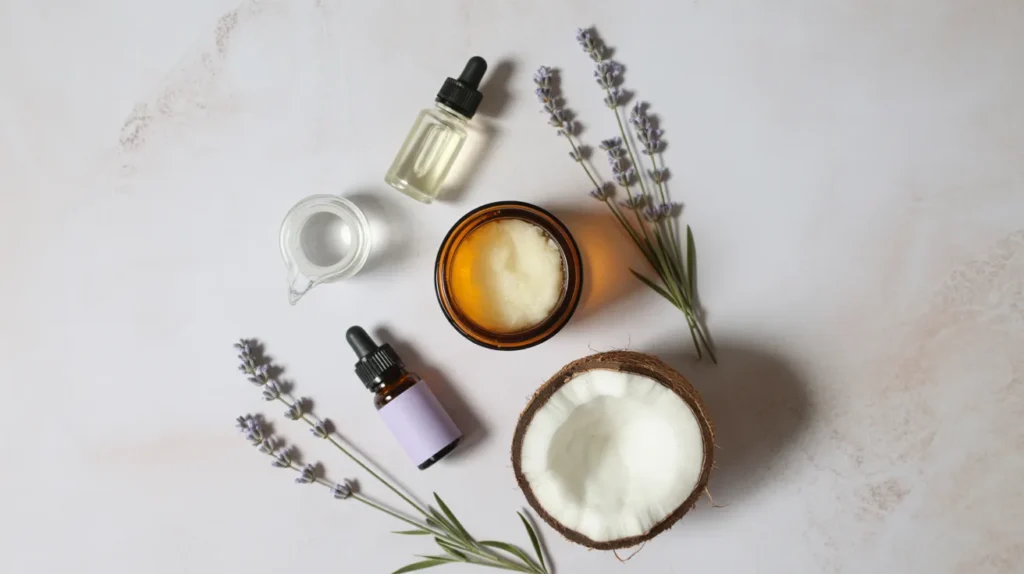
- ✦ Optional: 3 drops tea tree or lavender essential oil
📋 HOW TO DO IT
- Warm oil between fingertips. Add essential oils if using — never undiluted on the scalp.
- Section hair and apply directly to the scalp. Massage in circular motions for 5–10 minutes.
- Leave 30 minutes. Shampoo twice to remove all traces.
4 DIY Coconut Oil Hair Masks
These are the masks we actually make. Each one uses coconut oil as its base and adds one or two other kitchen ingredients that do a specific job. All four have been through the mess-on-the-bathroom-floor testing phase, and all four came out the other end worth sharing.
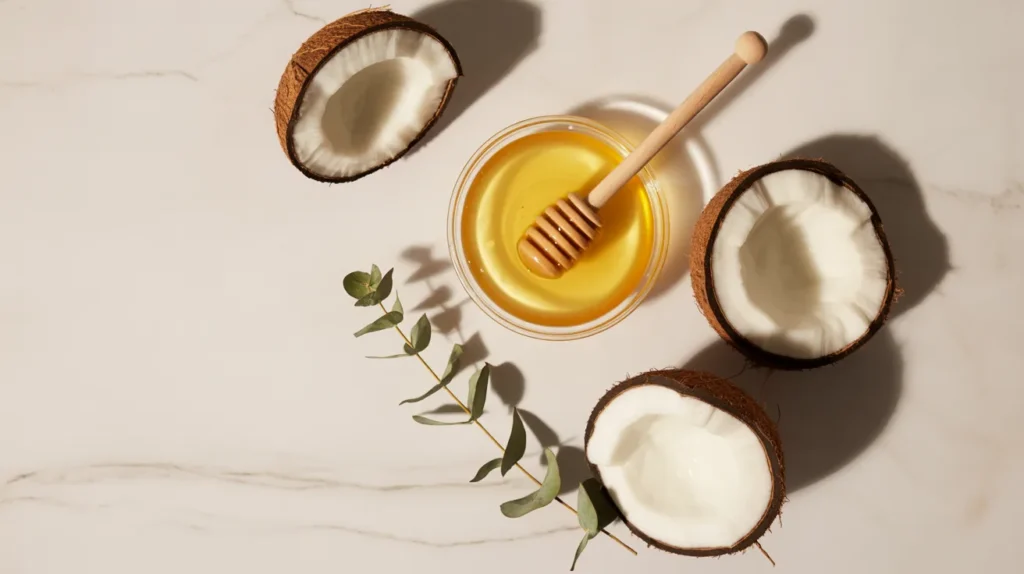
Mask 1 — Classic Coconut Oil & Honey Mask ⭐
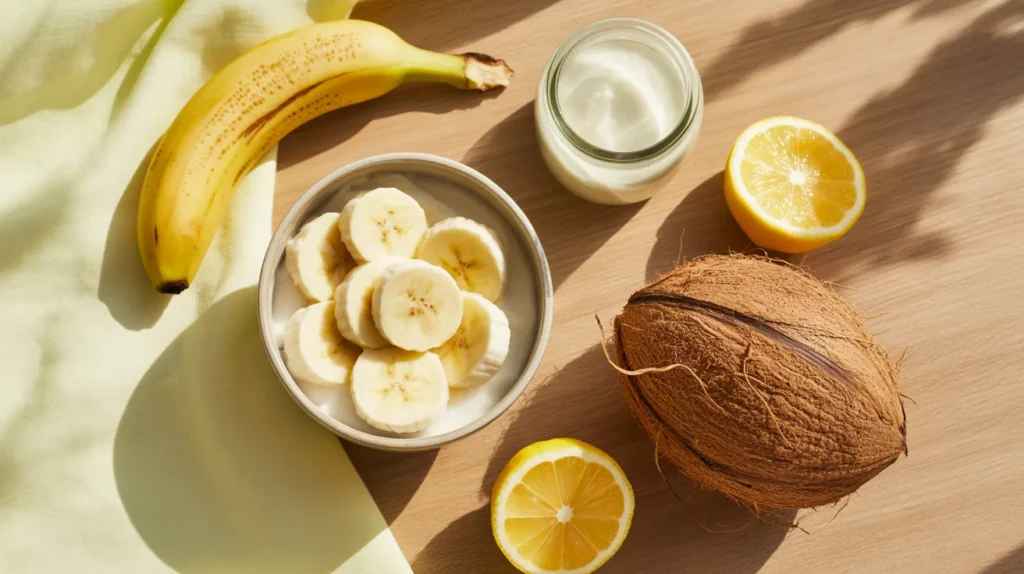
Mask 2 — Banana & Coconut Oil Repair Mask
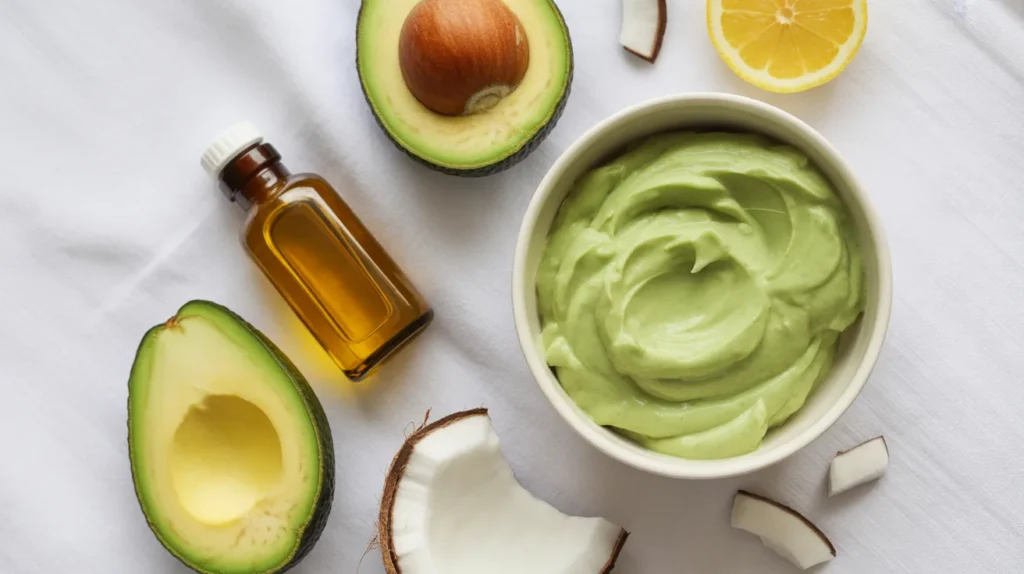
Mask 3 — Avocado & Coconut Oil Shine Mask
Mask 4 — Quick Scalp Soothing Mask
Common Coconut Oil Hair Mistakes to Avoid
Most coconut oil for hair horror stories come from one of these eight mistakes. Every single one of them is something we did ourselves before we knew better. Fix these and the results are almost guaranteed to improve.
❌ Using Too Much
A dime-to-hazelnut sized amount is enough for most hair lengths. More does not mean better — it means greasy, weighed-down hair that takes three washes to recover from.
❌ Applying to Roots on Fine Hair
The natural sebum from your scalp is usually enough for fine hair roots. Start applications at ear level and work downward.
❌ Using Refined Coconut Oil
High-heat processing strips the beneficial compounds. Always use unrefined, cold-pressed, virgin coconut oil. If it doesn’t smell like coconuts, it’s the wrong one.
❌ Not Washing It Out Properly
Apply shampoo to dry oiled hair before wetting. This counter-intuitive step removes oil far more effectively than shampooing wet hair first.
❌ Applying to Soaking Wet Hair
Water fills the shaft when hair is soaking wet, blocking oil absorption. Apply to dry hair for best results, or towel-dried hair for finishing.
❌ Using It Daily
Coconut oil is a weekly ritual, not a daily conditioner. Weekly pre-wash is the sweet spot. Over-use causes buildup that makes hair feel heavy and dull.
❌ Using It on an Oily Scalp
Coconut oil on a dry scalp is soothing. On an oily or congested scalp, it makes things noticeably worse. Know which you have before you start.
❌ Expecting Overnight Transformation
The real benefits — reduced breakage, better elasticity — become visible after four to six weeks of consistent weekly use. One application gives you a lovely result; four weeks gives you different hair.
📚 Sources & Scientific References
We are not trichologists or cosmetic scientists—we’re two people who started using coconut oil because Rita read something about lauric acid and Doo was willing to be the test subject. But we wanted to understand what was actually happening inside the hair shaft and whether the results we were noticing had a scientific basis. Here are the three published studies we found most relevant and credible.
🧪 How We Tested These Methods — & Why It Matters
Using coconut oil for hair has been part of our weekly routine since 2019—and with that visibility has come an enormous range of claims—articles promising it will reverse years of damage overnight, comments insisting it permanently destroyed someone’s curl pattern. The truth, based on seven years of personal use and a careful reading of the research, sits somewhere more ordinary and more honest than either extreme.
Here is what “tested by us” actually means in this guide:
🥥 Rita’s weekly routine for seven years
Not during a trial period — every wash day since 2019. The observation about less breakage by week two is something she mentioned at the time, not something we remembered later. Doo started six months after, after noticing the difference in her ends.
⚠️ The “too much” warning is from experience
Rita used closer to two tablespoons in the early months, every wash. By week three her hair was heavier and took three shampoo rounds to feel clean. Scaling back to a pea-to-hazelnut amount resolved it immediately.
💆 The fine hair note comes from a friend
We tried the post-wash leave-in on a friend with fine, low-porosity hair. The same pea-sized amount that works on Rita’s ends left her hair flat and greasy by midday. She now uses argan oil instead.
🍌 The blender instruction is a hard-won lesson
The first time Rita made the banana mask, she mashed by hand. Twenty minutes picking lumps out of her hair. The instruction to use a blender is in the recipe because we know exactly what happens when you skip it.
🧴 The oily scalp note is based on Doo’s experience
Doo tried the scalp massage during a period when his scalp was oily rather than dry. Two weeks noticeably worse — more buildup, more irritation. The guidance is based on that experience, not a general disclaimer.
📚 We’re honest about what the science says
The Rele & Mohile (2003) study is well-designed and important. But it’s a laboratory study. It doesn’t prove that home use produces identical results. We include it because it explains the mechanism — not because it guarantees an outcome.
🌿 Coconut oil for hair is a traditional practice that became a personal habit. We started because the science was interesting, kept going because the results were real, and wrote this guide because the information we found online was either wildly overstated or frustratingly vague. If something in this guide doesn’t work for your hair — or works differently than we described — we’d genuinely like to know.
Frequently Asked Questions
Complete Your Natural Haircare Routine
Coconut oil works best as part of a wider natural hair care practice. Here’s what we pair it with across the week:
The scalp oil we pair with pre-wash coconut oil application. A Sunday night classic.
The post-wash rinse that pairs perfectly with a coconut oil pre-wash routine.
The lighter alternative for fine hair that can’t handle coconut oil on its own.
Doo and Rita are the creators of Nature’s Herbal Remedy, a natural wellness blog focused on plant-based haircare, skincare and everyday self-care. They have been testing, adjusting and debating these methods in their own bathroom for over six years. Every technique on this page is something they actually use — nothing is published without being tried on at least one head first. Last updated: May 2026.